Showing posts with label ancient. Show all posts

Friday, 11 June 2010

The Mystery of York’s Headless Romans


by Kathryn Hadley,


Has the mystery of York’s headless Romans, which has puzzled archaeologists for over six years, finally been solved? In 2004, York Archaeological Trust excavated 80 burials in York in advance of housing developments. The burials are believed to be part of a large Roman cemetery on the outskirts of the town, dated to between the early 2nd century and late 3rd century.

However, the burials do not fit in with the usual demographics for a Roman cemetery. They are mostly male and the majority are adults. The people also seem to have suffered harsh lifestyles and met violent deaths; nevertheless, they appear to have been carefully buried. There is evidence, for example, that funerary feasting took place at the cemetery. Were these people soldiers, criminals or gladiators? Were they from a group that had unusual religious beliefs or burial practices?

On Monday, June 7th, archaeologists announced the results of the latest forensic tests carried out on more than 80 skeletons. They believe that the individuals may be gladiators and that the site may be the best preserved gladiator graveyard in the world. Scientists discovered a large carnivore bite mark, believed to have been inflicted by a lion, tiger or bear in the context of an arena. They also found some healed and unhealed weapon injuries, possible hammer blows to the head and a high incidence of substantial arm asymmetry. The development of much stronger muscles in the right arm is a feature that is notably mentioned in several works of ancient Roman literature in connection with gladiators.

Kurt Hunter Mann, who is leading the research at York Archaeological Trust, explained the different possible theories:

‘There are numerous pieces of evidence that point towards or are consistent with
the interpretation that the skeletons are Roman gladiators, but there is also
other evidence that suggest the individuals could have been soldiers, criminals,
or members of a religious cult […].
‘An alternative interpretation – that
the individuals are soldiers – is potentially undermined by the fact that most
of them have been violently decapitated and that one of them has a large
carnivore bite mark, almost certainly sustained in an arena context […].
‘Another potential interpretation – that they are all criminals – appears to
be undermined by the substantial respect (and grave goods) with which many of
them were buried.’


On Monday, a documentary entitled Gladiators: Back From The Dead, exploring the origins of the skeletons and following the lead theory that they were Roman gladiators will be shown on Channel 4 (9pm). York Archaeological Trust will also launch a website next week presenting all the various theories and asking members of the public to give their own opinions.

http://www.headlessromans.co.uk/


Image:

Skeleton with displaced skull - York Archaeological Trust

Tuesday, 2 March 2010

The Multicultural Origins of Roman York

by Kathryn Hadley

According to the latest research by the University of Reading’s Department of Archaeology, published in the March issue of the journal Antiquity, 4th-century Roman York was a multicultural town where individuals of North African descent moved in the highest social circles.

Archaeologists used the latest techniques in forensic ancestry assessment and isotope analysis to study Romano-British skeletal remains, in particular those of the ‘Ivory Bangle Lady’, discovered in a stone coffin in August 1901 near Sycamore Terrace in York. The research was funded by the Arts and Humanities Research Council (AHRC).

Strontium and oxygen isotopes are incorporated into the skeletal tissues of humans through the food and drink they ingest. Isotope analyses thus enable scientists to identify where individuals resided at the time of tissue formation in terms of geology (strontium) and climate (oxygen). The ancestry assessment and isotope signature of the ‘Ivory Bangle Lady’ suggests that she was of mixed ‘black’ and ‘white’ ancestry and may have come from somewhere slightly warmer than the UK.

Her grave is believed to date to the second half of the 4th century and contains jet and elephant ivory bracelets, earrings, pendants, beads, a blue glass jug and a glass mirror. These grave goods, as well as evidence of an unusual burial technique, further indicate that she was of high social status and not native to York. She may have been of North African descent and migrated to York from the Mediterranean.

In the words of Dr Hella Eckardt, Senior Lecturer at the University of Reading:
‘Multi-cultural Britain is not just a phenomenon of more modern times. Analysis
of the ‘Ivory Bangle Lady' and others like her, contradicts common popular
assumptions about the make up of Roman-British populations as well as the view
that African immigrants in Roman Britain were of low status, male and likely to
have been slaves.
‘To date, we have had to rely on evidence of such foreigners in Roman Britain from inscriptions. However, by analysing the facial features of the Ivory Bangle Lady and measuring her skull compared to reference populations, analysing the chemical signature of the food and drink she consumed, as well as evaluating the evidence from the burial site, we are now able to establish a clear profile of her ancestry and social status.
‘It helps paint a picture of a Roman York that was hugely diverse and which included
among its population, men, women and children of high status from Romanised
North Africa and elsewhere in the Mediterranean.’


The findings will feature in the Yorkshire Museum’s new exhibition ‘Roman York: Meet the People of the Empire’ due to open in August.
Read the press release on the website of the Yorkshire Museum.


Images:
- Reconstructed portrait of the Ivory Bangle Lady by Aaron Watson, University of Reading
- Gravegoods (copyright Yorkshire Museum)

Wednesday, 17 February 2010

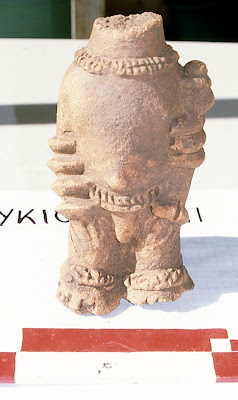
Mysterious ancient clay figures unearthed in Ghana

by Kathryn Hadley

Manchester University announced yesterday, February 16th, the discovery of 80 ancient clay figures in Ghana by archaeologists from the universities of Manchester and Ghana. The sculpted human and animal figures, which are believed to be between 1,400 and 800 years old, were unearthed last month from a series of mounds in a remote region of Northern Ghana near the village of Yikpabongo. The 30km square area is so densely packed with a series of mysterious mounds that it took just two weeks to excavate the 80 figures.

Human skulls were also discovered in the mounds. Dr Benjamin Kankpeyeng from Ghana and Tim Insoll from Manchester University believe that they may be the sites of ancient shrines. It is hoped that studies of the number, context and arrangement of the figurines will provide an insight into the ritual practices and beliefs of this ancient society and deepen our understanding of what remains a relatively unknown and little-researched page of African history.

In the words of Professor Tim Insoll:

‘These finds will help to fill a significant gap in our scant knowledge of this
period before the Islamic empires developed in West Africa. They were a
sophisticated and technically advanced society: for example some of the
figurines were built in sections and slotted together.’

Dr Benjamin Kankpeyeng further explained:

‘The relative position of the figurines surrounded by human skulls means the
mounds were the location of an ancient shrine. The skulls had their jaw bones
removed with teeth placed nearby - an act of religious significance.’

However, illegal excavation of the treasures means that archaeologists are in a race against time to ensure the safety of the remains.

Residues of material were also discovered packed into holes within the figurines. What exactly was put into the holes - medicinal substances, blood or other material from a sacrifice - is unknown, however. Some of the figures have been brought back to the UK where Professor Insoll is due to carry out further analysis of these residues in an effort to uncover more clues about the society.

The burial sites have been repeatedly excavated over the past 25 years. The first excavation took place in 1985 with others in 2007, 2008 and 2009 carried out by the University of Ghana. Nevertheless, many questions remain unanswered.
Insoll explained:

‘There are still many questions remaining: some of the figurines were
deliberately broken and placed besides body parts. Why?’

Kankpeyeng added:

‘What is interesting is that the people now living in this area seem to have no
connection with the makers of the figurines. That would suggest that that they
have more in common with peoples living in other parts of West Africa - but we
need to do more work before we can be certain.’

Wednesday, 3 February 2010

The Oldest Roman Coin in Britain

by Kathryn Hadley

Leicestershire County Council announced, at the end of last week, the recent discovery of the oldest Roman coin ever found in Britain in the collection of the Harborough Museum. The silver denarius, which is believed to date to 211BC, was discovered by metal detectorist Ken Wallace, in 2000, amongst over 5,000 other coins at a Late Iron Age shrine of the Corieltavi tribe near the village of Hallaton, Leicestershire.

According to archaeologists, the site was a type of open air shrine, which was used from around 50BC through to the Roman invasion in AD43. The gold and silver coins and other treasures discovered at the site, including an elaborately decorated Roman cavalry helmet and the remains of over 300 pigs, are believed to have been buried as gifts to the gods.

The front of the denarius features a depiction of the goddess Roma; the reverse, is engraved with an image of the mythical twins Castor and Pollux sitting astride galloping horses. Denarii were first struck in Rome in 211BC, making the Hallaton coin a very early version. How the coin came into the possession of the Creiltavi tribe remains a mystery. Whilst it may have arrived in the purse of an invading Roman soldier after the conquest in 43AD, some archaeologists believe that Roman Republican coins found their way into Britain before the conquest through trade or diplomacy.

The previous oldest known Roman coin in Britain, discovered by metal detectorist Malcolm Langford in Berkshire, is believed to date to 207BC. It was recorded by the Portable Antiquities Scheme last year.

A Leicestershire Council Officer explained:


‘we knew we had a coin dating to 211BC amongst the coins from the Hallaton
Treasure but only realised its full significance after a coin dating to 207BC
was publicised as the oldest Roman coin found in Britain’.


The coin is currently on display at Harborough Museum in the specially designed Hallaton treasure gallery which opened in September 2009.

Harborough Museum
Council Offices
Adam & Eve Street
Market Harborough LE16 7AG
Telephone: 01858 821 085


For further information on Roman Britain, visit our Ancient Rome focus page.

Wednesday, 25 November 2009

How the astronomical alignment of Greek temples reflects cultural and ethnic identities

by Kathryn Hadley
Historians and archaeologists have long sought to establish links between the positions of classical temples and cultural and religious practices. Many have speculated that classical temples may have been aligned with respect to sunrise and argued that temples could be dated from their astronomical alignment. There is no consensus, however.

Dr Alun Salt, from the School of Archaeology and Ancient History at the University of Leicester, explained the controversy:
‘There are quite a few temples in Greece which don't face sunrise. So a few
archaeologists have suggested that there is nothing significant about the number
that face east. The problem is that no one has ever said what a 'significant
number' would be.’

Salt has recently conducted a survey of archaic and classical Greek temples in Sicily and Greece. Through a comparison of the alignment patterns of temples in the two countries, he sought to determine the extent to which Greek culture differed in Sicily and Greece. His study was published last week, on November 19th, on the website PLoS ONE in the article ‘The Astronomical Orientation of Ancient Greek Temples’.

Do the alignments of Ancient Greek temples in Sicily and Greece reflect astronomical intentions? How do they reveal different pressures in the expressions of ethnic identity? How far are they evidence of a degree of cultural continuity across the Mediterranean?

Applying mathematical principles of probability to his survey, Salt discovered that many classical temples in Sicily were built to face the rising sun. Indeed, of a total of 41 temples surveyed in Sicily, only one faced west. He explained how in Greece, however, the situation is ‘quite complicated’.
‘It would be like spinning a roulette wheel and finding that half the time the
ball bounces out of the wheel. But when it does land, 90% of the time it'll be
on red. That looks odd to me.’

According to Dr Salt, the results may imply that there is an ‘astronomical fingerprint’ for Greek settlers in the Mediterranean. If all the temples founded by Greek settlers were built following similar alignment patters this may help to distinguish between the sites settled by people following the Greek religion and natives who adopted Greek style through trade, but kept their own culture.

There remain a number of unanswered questions, however. Salt explained:
‘What’s really interesting are the temples which don't fit. The temple of
Hekate, a lunar goddess, at Selinous faces west. If every other temple in Sicily
faces east, then what is special about that one?’

In Greek Archaeology from Schliemann to Surveys Graham Shipley considers how new archaeological discoveries and techniques are progressively refining our views of Classical Greece.

Friday, 20 November 2009

The fight to subdue the Scots and for children's rights

20th anniversary of the Convention on the Rights of the Child
The Convention on the Rights of the Child was signed in 1989 and has since been ratified by 193 countries. Only the United States and Somalia have yet to adhere to the convention.
The Convention was the first legally binding international convention to affirm human rights for all children. It spells out the basic human rights that children have everywhere in the world in 54 articles and 2 optional protocols including the right to survival, to develop to the fullest, to protection from harmful influences, abuse and exploitation, and to participate fully in family, cultural and social life. The Convention adheres to four core principles: non-discrimination, devotion to the best interests of the child, the right to life, survival and development, and respect for the views of the child.
An official commemorative ceremony will be held in New York today to mark the event.
In an article of the website of UNICEF Dan Seymour, Chief of the Gender and Rights Unit of UNICEF’s Policy and Practice Division, assesses the achievements of the Convention and the remaining challenges.
In Paris, a photographic exhibition entitled ‘Sale gosse!’ is on display at the headquarters of UNESCO (Salle Miro, 7 Place de Fontenoy) until December 10th. A slideshow of some of the photographs is available on the website of Le Figaro.

More Roman military camps in Scotland than in any other European country
There exist at least 225 Roman military camps in Scotland against an estimated 150 in England. The Scotsman reports on the announcement of a new comprehensive survey of Roman remains in Scotland to be carried out by archaeologists from Historic Scotland. It is believed that the survey will uncover previously undiscovered Roman sites boosting the total of officially recognised sites and giving them increased legal protection.

Restoration of Crux Vaticana
The Crux Vaticana was unveiled by the Vatican, yesterday, after a two-year restoration project. The jewel encrusted golden cross is a foot-high and contains what is revered as fragments of the cross on which Jesus was crucified. It was given to the people of Rome sometime between 565 and 578 by the Byzantine emperor Justin II. Nicole Winfield reports on the website of The Scotsman.

Photo:
By Francois Perri, from the exhibition 'sale gosse' held at UNESCO in Paris

Wednesday, 23 September 2009

The Archimedes Codex: Neumann Prize Winner and the story of Archimedes’ lost manuscripts


by Kathryn Hadley

Last Saturday, September 19th, at the autumn meeting of the British Society for the History of Mathematics (BSHM), The Archimedes Codex by Reviel Netz and William Noel was awarded the Neumann Prize for the best book in the history of mathematics aimed a broad audience. Reviel Netz is Professor of Classics at Stanford University, California, and Dr William Noel is the curator of manuscripts and rare books at The Walters Art Museum in Baltimore, Maryland.

The prize was awarded for the first time this year and will henceforth be bestowed every two years. The prize is named after Dr Peter Neumann, Emeritus Fellow of The Queen’s College, Oxford, and a former president of the BSHM. He was awarded the OBE in 2008 for his services to education.

The Archimedes Codex is a biography of one of the ancient world’s greatest mathematicians Archimedes of Syracuse (c.287 BC – c.212 BC) and tells the story of the rediscovery of a 10th-century copy of some of his writings and drawings, which were found hidden beneath a 13th-century prayer book.

The only historic sources about Archimedes are three manuscripts, two of which have disappeared. The third is the Archimedes Palimpsest. The word palimpsest comes from the Greek palimpsestos meaning ‘scraped again’ and is a manuscript from which the text has been erased and the parchment re-used. In the case of the Archimedes Palimpsest, the manuscript containing the mathematician’s work was erased and re-used as a Byzantine prayer book written in Greek and completed in 1229. It contains seven treatises by Archimedes, including The Method of Mechanical Theorems and the Stomachion, which allegedly exist nowhere else in the world.

In October 1998, the manuscript was sold at auction to a private collector who deposited it at The Walters Art Museum. The Archimedes Codex chronicles the project led by William Noel to recover and decipher the erased text and investigates why the text is so important. The Walters Art Museum also created a digital version of the text, which is available on the Archimedes Palimpsest project website.

Professor Martin Campbell-Kelly from the University of Warwick was the chair of the judging panel. He said that:
‘although the panel was faced with a strong shortlist of books The Archimedes
Codex, with its readable combination of history and modern scientific sleuthing,
emerged as a clear winner’.

The British Society for the History of Mathematics was founded in 1971 to promote and encourage research in the history of mathematics and its use at all levels of mathematics education. The annual joint BSHM / Gresham College lecture will be held at Gresham College on November 2nd. Professor Jeremy Gray from the University of Warwick will give a talk entitled ‘Mathematics, motion and truth: the Earth goes round the Sun’ in which he will address the debates surrounding the reality of the Earth’s motion around the Sun from the early 17th century to the time of Poincare.
http://www.gresham.ac.uk/
www.dcs.warwick.ac.uk/bshm

For further information on the making and the history of the palimpsest and on the project itself visit the Archimedes palimpsest website
http://www.archimedespalimpsest.org/

Archimedes was one of the first mathematicians to approximate the value of π (pi). The mathematics teacher William Jones was the first, however, to use a symbol to represent the concept of pi. In William Jones and his Circle: The Man who invented Pi Patricia Rothman discusses Jones’s significance among his contemporaries and the unique archive that forms his legacy.

For further information on the history of science, visit our History of Science focus page. For further information on ancient Greece, visit our Ancient History focus page.

Wednesday, 9 September 2009

Gladiators Were Vegetarians


by Kathryn Hadley

Gladiators were mostly vegetarians and their diets consisted, above all, of barley and vegetables. They were neither too poor to buy meat nor staunch defenders of animal rights; instead, their carbohydrate-rich diets made them put on weight, which both protected them during fights and made them appear more spectacular, which pleased the crowds.

A 200-square-foot plot of land in the city of Ephesus (now in western Turkey), alongside the road that originally led from the city centre to the Temple of Artemis, is the world’s only known gladiator graveyard. The plot contains the bodies of just over 60 gladiators. Karl Grossschmidt, a paleo-pathologist from the Medical University of Vienna, recently led a research project about gladiator life, the diets of gladiators and the causes of their deaths. Scientists carried out isotopic analyses of bone fragments from the graveyard, measuring trace chemical elements such as calcium, strontium and zinc. The results of the study were reported in an article by Andrew Curry published in the November/December issue of Archaeology magazine (a publication of the Archaeological Institute of America).

In contemporary accounts of gladiator life gladiators were often referred to as hordearii, which literally means ‘barley men’. The results of the bone analyses revealed that gladiators ate considerably more plants and very little animal protein compared to the average inhabitant of Ephesus. Their diets were extremely high in carbohydrates such as barley and legumes, which made gladiators put on weight. The extra layers of subcutaneous fat helped to protect them from surface wounds during fights. However, their diets lacked in calcium and gladiators allegedly drank brews of charred wood or bone ash, which contained particularly high levels of calcium, to keep their bones strong.

What was the purpose and significance of gladiatorial shows in Ancient Rome? For further information, read our article Murderous Games: Gladiatorial Contests in Ancient Rome
For further reading, visit our Ancient Rome focus page.

Wednesday, 8 July 2009

The world’s oldest bible reunited online


by Kathryn Hadley

Following a four-year project, over 800 pages and fragments from the Codex Sinaiticus, the world’s oldest surviving Christian bible, have been successfully virtually reunited and are now available online at http://www.codexsinaiticus.org/. For the first time, it is possible to view high resolution digital images of all the extant pages of the fourth-century book and to research in depth the Greek text, which is fully transcribed and cross-referenced.

The digitalisation of the text is the result of a partnership between the British Library, Leipzig University Library, St Catherine’s Monastery in Sinai, Egypt, and the National Library of Russia in St Petersburg, each of which hold different parts of the physical manuscript. The Codex Sinaiticus Project was launched in 2005 in an attempt to reunite the surviving pages of the document which have been kept in different locations for over 150 years and to encourage the publication of new research into the history of the Codex.

In the words of Dr Scot McKendrick, Head of Western Manuscripts at the British Library:


‘The Codex Sinaiticus is one of the world’s greatest written treasures… This
1600-year-old manuscript offers a window into the development of early
Christianity and first-hand evidence of how the text of the bible was
transmitted from generation to generation. The project has uncovered evidence
that a fourth scribe – along with the three already recognised – worked on the
text; the availability of the virtual manuscript for study by scholars around
the world creates opportunities for collaborative research that would not have
been possible just a few years ago.’

The online transcription also includes previously unseen pages of the manuscript. Professor David Parker from the University of Birmingham’s Department of Theology directed the team that worked on the electronic transcription. He explained how:


‘The transcription includes pages of the Codex which were found in a blocked-off
room at the Monastery of St Catherine in 1975, some of which were in poor
condition. This is the first time that they have been published.’

The Codex Sinaiticus was written by hand in uncial letters on vellum parchment in the mid-fourth century around the time of Constantine the Great. Although it originally contained the whole of the Old and New Testaments, half of the Old Testament has since been lost. It is believed that the Codex would have originally contained around 1,460 pages. The surviving manuscript concludes with two early Christian texts, an epistle ascribed to the Apostle Barnabas and ‘The Shepherd’ by Hermas, which were subsequently dropped from both Catholic and Protestant bibles. Codex Sinaiticus is named after the Monastery of St Catherine at the foot of Mount Moses in Sinai built between 527 and 565 by the order of the Emperor Justinian to house the remains of the Christian martyr St Catherine.

The Codex is also particularly significant because it is believed to be one of the oldest bound books. Dr McKendrick described the Codex Sinaiticus as:


‘a landmark in the history of the book, as it is arguably the oldest large bound
book to have survived. For one volume to contain all the Christian scriptures
book manufacture had to make a great technological leap forward – an advance
comparable to the introduction of movable type or the availability of word
processing. The Codex was huge in length – originally over 1460 pages – and
large in page size, with each page measuring 16 inches tall by 14 inches wide.
Critically, it marks the definite triumph of bound codices over scrolls – a key
watershed in how the Christian bible was regarded as a sacred text.’

To celebrate the online reunification of the Codex, ‘From Parchment to Pixel: The Virtual Reunification of Codex Sinaiticus’ opened on Monday July 6th at the British Library. The exhibition presents the newly reunified Codex Sinaiticus and the associated project through a display of historic items, interactive representations of the manuscript and other relevant artefacts and events, such as historical news footage, blown up details of Codex Sinaiticus pages, and digital reconstructions of the textual development of certain pages. For the very first time, the two volumes of the Codex Sinaiticus held at the British Library will also be on display in the Treasures Gallery.

For further information on the history of the Codex Sinaiticus, read our article

From Parchment to Pixel: The Virtual Reunification of Codex Sinaiticus
Until September 7th
The British Library
96 Euston Road
London NW1 2DB
http://www.bl.uk/
Pictures:
- Codex Sinaiticus detail from the Book of Psalms (British Library)
- Codex Sinaiticus open at John chapter 5 (British Library)
- Codex Sinaiticus detail showing a skeletal parchment feature on Quire 41 (British Library)

Monday, 11 May 2009

Pavlopetri: the preservation of the oldest submerged town in the world

by Kathryn Hadley

Pavlopetri lies three to four metres beneath the sea off the coast of southern Laconia in Greece. With parts of its ruins dating back to at least 2800BC, it is considered the oldest submerged town in the world. Some of the town’s buildings, courtyards, streets, chamber tombs and some 37 cist graves, from the later Mycenaean period (c.1680-1180 BC), have been preserved almost intact. The site is, nevertheless, in need of active efforts to preserve and document what remains of this period of Greek history. The coast of southern Laconia is a popular tourist destination and boats dragging anchors, snorkelers and the growth of marine life are a constant threat to the 3,500 year old walls.

The University of Nottingham announced, today, May 11th, the beginning of a project led by Dr Jon Henderson, from the Underwater Archaeology Research Centre (UARC) in its Department of Archaeology, to undertake a full underwater survey of the site. No work has been carried out on the site since it was first mapped using hand tapes, in 1968, by a team from the University of Cambridge. Dr Henderson is the first archaeologist to have official access to the site in 40 years.

Dr Henderson described one of the aims of the project:

‘This site is of rare international archaeological importance. It is imperative
that the fragile remains of this town are accurately recorded and preserved
before they are lost forever. A fundamental aim of the project is to raise
awareness of the importance of the site and ensure that it is ethically managed
and presented to the public in a way which is sustainable and of benefit to both
the development of tourism and the local community.’

The power of the Mycenaean civilisation was largely based on their control of the sea. However, archaeological studies have, to this date, mostly focused on better known inland palaces and citadels and their remains a lack of knowledge about the workings of harbour towns during the period. It is believed that Pavlopetri, in particular, with its sandy and well-protected bay, was an important harbour where local and long-distance trade was conducted throughout the Mediterranean.

The current project will research the history and development of the harbour, when it was occupied and what it was used for. A study of the geomorphology of the area will also seek to provide an insight into why the town disappeared under the sea. The first detailed digital underwater survey of the site will be carried out this month and in June, using an acoustic scanner which can produce three-dimensional digital surveys. There will be three further sessions of underwater excavations between 2010 and 2012. A study session is planned for 2013 and the results of the research are due to be published in 2014. Dr Nicholas Flemming, who first discovered the town in 1967, is also involved in the current project.

The Mycenaean civilisation was the first Greek-speaking civilisation, named after Mycenae, its most important site, in the Peloponnese of southern Greece. The population was ruled by a number of independent rulers, who each had their own stronghold. They notably conquered Crete in approximately 1450 BC, where they adapted the Linear A script to write their own language (Linear B). The Mycenaean period is also referred to as the Bronze Age period in Greek history and notably provided the historical setting for a considerable part of Ancient Greek literature and myth, including Homer’s Age of Heroes.
Pictures: above: outline of a building;
middle picture: one of the 37 cist graves
(University of Nottingham)

Friday, 8 May 2009

Discovering and Documenting Rome’s Catacombs

by Kathryn Hadley

The catacombs of Rome are a series of underground Christian, Jewish and pagan burial sites, which date back to the 2nd century AD, when the Christians of Rome began to bury their dead underground. There are over 40 catacombs in total, which extend over 170km (105 miles). In the 16th century, Antonio Bosio (1575-1629) explored the catacombs for the first time and research continued to the present day. Nevertheless, the catacombs have not yet been fully documented and, although the general lines of their development and origins have been studied, the individual history of each catacomb remains unknown. Due to safety concerns, only approximately 500 metres of the galleries are currently accessible to the public.

At the beginning of this year, however, a team of ten Austrian and Italian computer scientists, archaeologists and architects completed the first part of a three-year project to construct a virtual model of the catacomb of Saint Domitilla. The model enables you to travel through walls, down corridors and into chambers and to view some of the vivid paintings on the walls of the burials.

In an article published on the website of the BBC, Dr Norbert Zimmerman, the leader of the project, from the Vienna Academy of Sciences, described the model:
‘It is not a virtual image, it is not animation - what you are seeing is real
data […] Its moving, 3D flexibility, gives you the chance to compare areas, to
assess the ways the Catacombs were developed over time, to analyse how and why
those who built them did what they did. That's never been possible before.’

Saint Domitilla is the largest catacomb of Rome with tunnels, caves, galleries and burial chambers stretching over approximately 15km (9 miles) on a number of levels. It comprises a series of isolated pagan tombs and early anonymous community burials, which date back to the 3rd century. Burial activities ceased in Saint Domitilla in the 5th century, but, the catacomb was thereafter used as a pilgrimage sanctuary with the graves of the martyrs Nereus and Achilleus, until the Middle Ages. The catacomb includes 80 painted tombs, representing one of the largest inventories of catacomb paintings.

The project began in January 2006 in an attempt to create a three dimensional model of the catacomb using laser scanners. Between January 2006 and the beginning of 2009, nine separate scanning campaigns were carried out documenting the entire accessible area of the catacomb. Following the completion of the first part of the project, the images have now been returned to Vienna to be studied in more detail and scientists are currently working on the repertory of the paintings. In October 2008, it was decided that the project would be extended for a further three years.

Dr Zimmerman explained that there were no current plans to scan the whole of the complex:
‘That is a big job, but it may well be needed if we are to really understand
this incredible historical phenomenon and if we are to make a proper detailed
study whilst these caves are still intact.’

He also confirmed plans to make most the results of the project available to the public:
‘We will publish our findings to reveal, for the first time, just how impressive
these tombs were and how the people of that time went to so much effort to bury
their dead.’

For further information, visit the website of the project http://www.oeaw.ac.at/antike/institut/arbeitsgruppen/christen/domitilla_engl1.html

Thursday, 30 April 2009

Return to the Roots of Marathon Running

by Kathryn Hadley

Almost 2,500 years ago, in 490 BC, the Athenian herald Pheidippides (530BC-490BC) ran 26 miles, from the battlefield near the town of Marathon to Athens, to announce the Greek victory over Persia in the Battle of Marathon. He allegedly delivered his message and thereafter collapsed and died. Despite the debates surrounding the historical accuracy of the legend of Pheidippides, it has inspired countless athletes to take up the challenge. Last Sunday, over 33,000 runners sought to rival Pheidippides in the streets of London and participated in the London Marathon. The marathon became an Olympic event in the first modern Olympic Games in Athens in 1896. The first London Marathon was held on March 29th, 1981.

The idea of organising a marathon race as an Olympic event was first suggested by the French philologist Michel Bréal (1832-1915) and was immediately supported by the founder of the International Olympic Committee, Pierre de Coubertin, and by the Greeks. The first Olympic Marathon, in 1896, was won by the Greek water-carrier, Spyridon Louis, who ran the race in 2 hours 58 minutes and 50 seconds. The marathon remained a male-only event until 1984, when the first women’s marathon was organised in the summer Olympics in Los Angeles. The event was won by the American athlete Joan Benoit in 2 hours 24 minutes and 52 seconds. The current world record for men was set at the Berlin Marathon in September 2008 by Haile Gebrselassie of Ethiopia, who ran the race in 2 hours 3 minutes and 59 seconds. Paula Radcliffe set the world record for women at the London Marathon in April 2003 in 2 hours 15 minutes and 25 seconds.

This year marked the 28th edition of the London Marathon founded by John Disley and Chris Brasher. In 1979, the two men ran the New York Marathon. Upon his return, Brasher described the event in article for The Observer entitled ‘The World’s Most Human Race’:

‘To believe this story you must believe that the human race can be one joyous
family, working together, laughing together, achieving the impossible. Last
Sunday, 11,532 men and women from 40 countries in the world, assisted by over a
million people, laughed, cheered and suffered during the greatest folk festival
the world has seen.’

He concluded the article by questioning:

'whether London could stage such a festival? We have the course, a magnificent
course … but do we have the heart and hospitality to welcome the world?’


Following the publication of the article, in early 1980, the editor of The Observer at the time, Donald Trelford, organised a lunch during which Disley and Brasher met with the relevant authorities who would be involved in organising the marathon in London, including the Greater London Council, the police, the City of London, the Amateur Athletics Association and the London Tourist Board. Although all parties seemed to support the idea, there were two main obstacles to holding a marathon in London. Which route would the race follow and how would it be possible to close off the necessary 26 miles of road without causing too much disruption? How would the race be funded?

Disley, first of all, drew a route which ran along the Thames and would only close down two bridges. The police allegedly approved of the route and the event gained the support of the Tourist Board, which encouraged the fact that the route passed by many of London’s historic sites, including Tower Bridge, the Docks, The Embankment, Big Ben and Buckingham Palace. Brasher thereafter drew up a budget for the first London marathon with an expenditure of £75,000 over and above any revenue expected from entry fees. The task of raising the necessary funds seemed an impossible feat. Shortly after, however, Gillette gave up their sponsorship of cricket’s Gillette Cup and agreed to become the first sponsor of the London Marathon signing a deal worth £75,000 a year for three years.

The first race was held five months later, on 29 March 1981. 20,000 people signed up to run the race. Only 7,747 entries were accepted, however, and there were 6,255 finishers. The event was hugely successful and the following year the race received over 90,000 applications. Over the past 27 years, from 1981 to 2008, a total of 711,260 runners have completed the London Marathon. John Disley remains chairman of the London Marathon Charitable Trust. Chris Brasher died in February 2003. Entries for the 2009 edition opened on Tuesday!

For further information on the Battle of Marathon and how it is still a byword for endurance, read our article Re-running Marathon

For further information on the Olympics, visit our History of Sport focus page.

Wednesday, 29 April 2009

Dish of a thousand flowers brought back to life


by Kathryn Hadley

Millefiori literally means ‘a thousand flowers’. This morning, a Roman millefiori dish, recently discovered in East London, was revealed to the public for the first time at the Museum of London Docklands. The dish is considerably rare and a true feat of craftsmanship and the find is unprecedented, not only in London, but in the Western Roman Empire. Further research is currently being carried out in order to establish whether or not similar bowls have been discovered in the Eastern Roman Empire.

The millefiori dish, which is made up of hundreds of indented glass petals in an intricate repeated pattern, was both a feat to manufacture and a feat to restore. Millefiore is a glass-working technique created from glass rods with multi coloured patterns that are only visible at the cut ends. The rods are cut and the sections are thereafter assembled to create a larger piece. In this particular case, the pattern consists of blue petals bordered with white. The blue petals were originally embedded in a bright red opaque glass matrix, which is still visible around the rim of each section of the rod. The dish was found held together by the soil around it. When it was lifted out of the soil it broke into little pieces, however, which it took Museum of London Archaeology conservator Liz Goodman three weeks to reassemble.

In her words:


‘Piecing together and conserving such a complete artefact offered a rare and
thrilling challenge. We occasionally get tiny fragments of millefiori, but the
opportunity to work on a whole artefact of this nature is extraordinary. The
dish is extremely fragile but the glasswork is intact and illuminates
beautifully nearly two millennia after being crafted.’

The dish was unearthed during excavations, led by L-P: Archaeology, of the Eastern cemetery of Roman London in Prescot Street, Aldgate. It was found alongside other glass and ceramic vessels in the grave of a Roman Londoner. Excavation work on this particular part of the cemetery began last April and lasted until September. The dish was discovered in September towards the end of the excavation work. In accordance with Roman law, the cemetery would have been located outside the city walls of Roman London. The cemetery is believed to have been in use from approximately 80AD to 400AD and, to this date, it has revealed 50 inhumations (burials) and 30 cremations. Although very little is known about the cemetery because it is situated under a hugely built-up area of London, mostly under roads, it is estimated that it may spread over almost 16 hectares and that only 15-20% of the area has currently been excavated.

Considerable post-excavation work and analysis now remains to be done, both on the dish and grave, as well as on the cemetery as a whole. Who was the owner of the dish whose cremated remains were found alongside the grave goods? When does the dish date back to? Why does the cemetery include both inhumations and cremations and what determined whether a Roman Londoner was cremated or buried?

The complex manufacture of the dish suggests that it would have been a valuable and highly-prized item. This suggests, in turn, that its owner was relatively wealthy. The millefiori technique is believed to have been particularly fashionable in the 1st and early 2nd centuries. However, the vessels discovered with the dish are of a later date, from the 3rd century. The design of the millefiori dish is allegedly slightly different to those previously discovered which date to the 1st and 2nd centuries. It may thus be possible that the dish is from the 3rd century, from the same period as the vessels. Nevertheless, it is also possible that the dish was of an earlier date and was passed down from generation to generation, which seems even more likely if it was a highly valuable item.

Why some Romans were cremated and others buried also remains a matter of speculation. It is possible that Roman Londoners had different religious beliefs. Another possibility is that customs changed over time and, given that the cemetery span over 400 years of Roman occupation, this seems a plausible explanation. It is an explanation that requires, however, considerable further research in order to date each of the bodies.

For further information about the excavation work carried out at Prescot Street, including videos and photos of the digs, visit the project website:
www.lparchaeology.com/prescot

For further information on Roman Britain, including articles on Roman attitudes to their British subjects and how archaeological discoveries have overturned accepted views about the Roman invasion of Britain, visit our Ancient Rome focus page.
Pictures: the Millefiore Roman bowl; fragments of the bowl; and the bowl and other vessels as they were discovered (Museum of London)

Friday, 24 April 2009

The Long and Winding Road to the Discovery of Cleopatra’s Tomb?


by Kathryn Hadley

Cleopatra’s tomb has never been found and its location remains uncertain.
22 bronze coins inscribed with Cleopatra’s name... An alabaster mask with a cleft chin resembling Mark Antony’s face... Shafts and tunnels beneath the temple of Taposiris Magna in Alexandria... The discovery, last week, of a nearby cemetery containing ten gilded mummies indicating the burial sites of members of the nobility…

A team of archaeologists from Egypt and the Dominican Republic believe that they may, at last, be on the path to the discovery of the tomb of Cleopatra and her lover Mark Antony. Evidence of their latest discoveries was presented, last Sunday, by Zahi Hawass, the head of Egypt’s Supreme Council of Antiquities, who claimed that:
‘This could be the most important discovery of the 21st century […] This is the
perfect place for them to be hidden.’

Previous archaeological research had focused on a site in Alexandria which had been submerged by the sea in an earthquake in the 8th century. Kathleen Martinez, a Dominican Republic scholar, initiated research at the current site, situated in Burg Al Arab, 30 miles (50km) west of Alexandria. The temple, devoted to the goddess Osiris, the god of the afterlife, was built by Ptolemy II (282-246 BC). Martinez has studied the life of Cleopatra for the past 12 years and has been working on the site with her team for three years. Following a series of radar surveys in March, archaeologists discovered three chambers buried almost 20 metres underneath the rock and Martinez believes that Antony and Cleopatra may be buried together in one of the chambers.

She was quoted in an article published by Reuters at the beginning of the week:
‘[Cleopatra] needed a place to be protected in the afterlife […] If she had used
the other burial site, she would have disappeared forever.’
Martinez explained that the couple would have been buried in a temple rather than in a public burial in order to protect them from the Romans and told The Associated Press that she believed them to be buried at Taposiris Magna
‘because it was the most sacred temple of its time.’

Cleopatra allegedly committed suicide by means of an asp bite on August 12th in 30 BC, aged 39, following her and Mark Antony’s defeat against Gaius Julius Caesar Octavian. The main source for her death and burial is provided by the posthumous account of Plutarch who wrote 130 years after the event and claimed that the two loves were buried together.

Archaeologists plan to start digging as soon as possible. At the beginning of the week, however, there were fears that digs would have to be postponed until the autumn for security reasons because the site overlooks the summer residence of the Egyptian President Hosni Mubarak!

For further information on our perceptions of Cleopatra, read our articles Cleopatra’s Make-over and Cleopatra: From History to Myth.

Tuesday, 31 March 2009

More Information on the Achaemenid Empire

by Kathryn Hadley

A couple of weeks ago, I wrote a short piece about the South Korean diplomat in Iran, who had attempted to smuggle an inscribed stone from Perspeolis from the Achaemenid era out of the country. Officials in Shiraz airport caught the thief and sent the stolen piece back to the ruins of Persepolis, but he was eventually released due to diplomatic immunity!

Persepolis was just one of the capitals of the Achaemenid Empire, which flourished from approximately 550 to 330 BC and was, at its height, the largest empire of the ancient world. Susa was another of its capitals and was rebuilt by Darius the Great (in the picture on my previous post). Alexander the Great also married in Susa, which therefater became part of the Seleucid Empire.

I have just come across a very useful blog post, which describes in greater detail the history of Susa and also has fascinating pictures of some of the reliefs which decorated the palaces of Achaemenid kings, many of which are now in the Louvre in Paris. Another post on the same blog also describes a statue of Darius the Great, which was found during excavations of the Great Gate in Susa in 1972. It provides detailed pictures and also explains the various inscriptions on the statue...

Well worth a visit if you are interested in finding out more about the Achaemenid Empire!

Wednesday, 18 March 2009

Mummies: The dream of everlasting life


by Kathryn Hadley

‘Mummies: The dream of everlasting life’ opened last week at the South Tyrol Museum of Archaeology in Bolzano, Italy. The exhibition includes a display of over 60 mummies, both human and animal, from all over the world, providing an insight into mummification from prehistory to the present day. Mummification is a phenomenon which occurred, and still occurs today, in different periods in time and in places all over the world. The mummies on display range from bog bodies discovered in northern Europe, to an Egyptian mummy complete with its sarcophagus, to mummies from Asia, Oceania and South America and include naturally mummified bodies, as well as mummies which are the result of human intervention. The main feature of the exhibition is the body of the 5,300 year-old Iceman Oetzi, discovered in the Alps in 1991. The mummies are displayed along with artefacts used in rituals and thus showcased in their cultural context. Interactive features also complete the exhibits with information on the origins, living conditions, nutrition and illnesses of the mummies, which extensive research and examination of the cadavers has revealed.

Mummies tend to be traditionally associated with Ancient Egypt and, for a long time, the term only referred to these embalmed corpses from Egypt. Mummification, however, describes the general process whereby the natural decomposition process of a body is inhibited and the corpse is preserved as a result of certain specific chemical, physical and climatic circumstances. Mummification can be applied to human bodies as well as animals and to bodies from any age in which the soft tissue has been preserved.

A distinction should be made between natural and artificial or intentional mummification, which involves an embalming process or laying the body in a natural area favorable to mummification. Natural mummification can occur in various environments, such as caves, deserts, ice and bogs. In caves, for example, the constant temperature, humidity and darkness prevents the growth of bacteria and mummies have notably been discovered in caves in desert areas, Siberia and in Central Europe. In desert areas, both hot and cold, bodies are naturally stripped of their fluids by aridity and wind and preserved as a result. Mummified corpses have also been discovered in salt deserts, salt lakes and seas, where the salt has dried out the body, preventing bacterial growth and eventually mummifying the corpse, as well as in bogs, where bodies are depleted from oxygen due to an excess of water and preserved by certain acidic and antibacterial substances.

Mummies have been discovered across the world, from Ancient Egypt, to Asia, South America and Europe. In Asia, both naturally and artificially mummified bodies have been found, primarily in desert areas. In South America, mummies have similarly been discovered mostly in desert areas on the Pacific coast and in the Andean mountain range. In some areas mummies were also intentionally mummified in accordance with the beliefs and cults of local Andean culture groups. In Europe, prehistoric groups did not practice mummification and mummified bodies were the result of natural preservation. In the late Middle Ages, however, mummies were brought to Europe from Egypt along with medical knowledge from the Orient and at the end of the 19th century, Napoleon’s Egyptian expedition gave rise to a second wave of imported mummies. Whilst in the Middle Ages in Europe only the bodies of emperors, kings and popes were embalmed, the process subsequently spread to members of the nobility as the practice of organising large and lavish funerals also developed. The practice continued during the 20th century. Lenin’s body has been preserved, for example, in a mausoleum in the Red Square since 1925; Eva Péron, who died in 1953, was also embalmed.

For further information about the process of mummification, read our article The Making of a Modern Mummy

Mummies: The dream of everlasting life
Until October 25th
South Tyrol Museum of Archaeology
Via Museo 43
I-39100 Bolzano
Italy
Telephone: 00 39 0471 320 100
http://www.archaeologiemuseum.it/
Photos: South Tyrol Museum of Archaeology. From top to bottom: Ancient Peruvian Mummy from the Inca period (Native American Dept. of Bonn University); Howler Monkey, Gran Chaco, Argentina (Schleswig Holstein Museum Found.); woman with two children, pre-Columbian period, South America (Reiss-Engelhorn-Museums, Mannheim); Michael Orlovits (1765-1806), Dominican Church of Vác, Hungary (Hungarian Natural History Museum).

Thursday, 5 March 2009

History's Greatest Lovers

by Derry Nairn & Kathryn Hadley

History has taught us that love and power can be both a scandalous and lethal combination. Choose any decade or royal household and you will likely turn up extra-marital excursions of some sort. Witness the lasting furores over president Sarkozy's alleged tryst a minister, over Princess Diana's various liasons, and over Bill Clinton's impeachment, and it is clear that these alliances continue to exert influence over public affairs. Here, we have selected just a few of the most interesting encounters from the past pages of History Today magazine...


Edward, & Mrs Simpson upset the apple cart

In 1936, Edward VIII abdicated on account of his relations with Mrs Wallis-Simpson, thus scandalising British society.
After a period of self-imposed censorship was brought to an abrupt halt, newspapers of the day devoted reams of print to the alleged 'intimacy', as they put it, between the king and his mistress, an American catholic two-time divorcee. George Bernard Shaw, the Irish playwright, had successfully predicted such a crisis in his 1929 playlet The Apple Cart, in which a fictional British king of the future causes ructions by insisting on marrying an unsuitable mistress. Stanley Baldwin's cabinet threatened to resign if the king went ahead with the marriage and a full-scale political crisis seemed imminent. In the event, the king stood by 'the woman he loved', and went into exile in Paris.

Read text from Shaw's play here, and about how it influenced the matter in this 2006 History Today piece. More on the background to the topic is to be found in this 2003 article


Edward II & Piers Gaveston - brothers of the flesh?

Gaveston was a close friend of Edward II, first as prince and then as king. J.S. Hamilton, in this article from History Today, argues that the close relationship between the two extended beyond the borders of 'brothers-at-arms'. Instead, says Hamilton,
Edward and Gaveston entered into 'illicit and sinful unions'. This homosexual tryst compromised the young king's relationship with his wife, Isabella, and indirectly, England's relationship with the French kingdom of her father, Philip the Fair. Although uncertainty still surrounds the nature of Edward and Gaveston's ties, one thing is definite: their close bonds were only brought to a halt upon the latter's execution in 1312 by the Earl of Lancaster.


The Prince Regent & Mrs Fitzherbert's dirty weekends.

Wallis-Simpson was certainly not the first nor the last less-than-suitable relationship that befell the English monarchy. George IV, as the young Prince of Wales, fell for Maria Anne Fitzherbert. After an affair that spanned years and took place primarily in Brighton, away from prying eyes (hence the origin of the phrase 'dirty weekend'), the Prince Regent allegedly wed his mistress in secret. This marriage was invalid owing to the would-be bride's catholic religion and status as a widow. Despite this, in the wake of George's death in 1830, Fitzherbert was offered the opportunity to become a duchess. She was not the flamboyant monarch's only affair, but she certainly seems to have been the most high profile.


Napoleon's many and various

In 1796, Napoleon I married Josephine de Beauharnais, a widow who had two children. She was six years his elder and was unable to bear him a son. In 1809, he divorced her and remarried to Marie Louise, the Archduchess of Austria, the following year. During his Egyptian campaign, Napoleon was known to have had an affair with Pauline Bellisle Foures, the wife of a junior officer, who became known as 'Cleopatra'. Napoleon’s illegitimate children were testimony to his other numerous mistresses. He acknowledged two of his illegitimate sons:

  • Charles Leon, by Louise Catherine Eléonore Denuelle de la Plaigne, who came from a middle class family and became Napoleon’s mistress in 1806, shortly after she divorced her husband, a former army officer who was sentenced to prison.
  • Count Alexandre Joseph Colonna-Walewski, by Countess Marie Walewska, a Polish Countess and wife of Count Athenasius Walewski.

Napoleon may have had at least three other unacknowledged illegitimate children. Victoria Kraus bore him a son and Albine de Montholon, the wife of Charles Tristan, marquis de Montholon, who stayed with Napoleon during his final years of exile on St Helena, bore him another daughter. He allegedly had another son, Jules Barthelemy-Saint-Hilaire, whose mother remains unknown.

For more information on Napoleon’s friendship with Betsy Balcombe on St Helena, read our article Betsy Balcombe and Napoleon.

For information on how Napoleon brought Europe to a pinnacle of monarchism, notably by placing members of his family on thrones across the continent, read our article Napoleon the Kingmaker

Alexander's orientalism

Alexander the Great married polygamously at least two ‘barbarians’, or non-Greeks. He married Roxane, the daughter of a Bactrian nobleman Oxyartes, from the region of Greater Iran, in 327 BC, and then married Stateira, a Persian princess and the daughter of Darius III of Persia, in 324 BC. Alexander allegedly also married a third wife Parysatis in Persia, although very little is known about her. He had at least one child with his Sogdian wife, Roxane. Upon the death of Alexander, Roxane allegedly murdered Stateira and her sister in 323 BC in Babylon, throwing their bodies into a well of cannibals.


Alexander married no Macedonian or Greek women and it has been argued that his marriages may have been motivated primarily by realpolitik, in an attempt to promote a policy of orientalisation, the promotion of a Greco-oriental political and cultural mix.


Alexander the Great is also believed to have had at least two male lovers: Hephaestion, a Macedonian noble and friend from boyhood, who held the position of second-in-command of Alexander’s forces, and Bagoas, a ‘barbarian’, Persian, and eunuch. The relationship between Hephaestion and Alexander has notably led to considerable historical speculation.


For further information on the legends and realities surrounding Alexander’s bride Roxane, read our article Alexander the Great's Little Star

For an insight into the personality of the man, who is remembered as one of the worlds’ greatest heroes, read our article Alexander the Great: Hunting for a New Past?


Wednesday, 18 February 2009

The Life of Meresamun


by Kathryn Hadley
The exhibition ‘The Life of Meresamun’ opened last week at the Oriental Institute Museum of the University of Chicago. Meresamun is believed to have been a singer priestess in 800BC at a temple in Thebes. Her remains are preserved in an unopened casket bearing an inscription of her name that was bought in Egypt in 1920 by the founder of the Oriental Institute, James Henry Breasted. In preparation for the exhibition, the casket was recently examined by CT scans to reveal its contents and over the past week, the Egyptian mummy consequently made the front pages of many newspapers.

Previous attempts to scan the contents of the casket in 1989 and 1991 were disappointing, only producing fuzzy images. The latest scans, however, revealed exceptionally clear and detailed images of the mummy, still wrapped in linen bandages. Scientists were notably able to view her remaining organs and what appear to be stones or pottery placed in her eye sockets. She was approximately five foot five inches tall and was in her late 20s or early 30s when she died. Her body showed no signs of childbearing and although her teeth were worn down, she appeared to be fit and healthy.

The American radiologist Professor Michael Vannier, who led the scanner team, described the results of the scans:
‘The pictures of the mummy are breathtaking, we could see subtle things - wear
patterns on the teeth, a clear view of the embalming incision, precise
indications of her age - that were not apparent before.’


‘The Life of Meresamun’ provides an insight into what her life would have been like both inside and outside the temple. The display includes objects that she would have used in the temple, such as a sistrum, an ivory clapper, a harp and cult vessels. The second part of the exhibition, which considers her life outside the temple and the social and legal rights of women in ancient Egypt, includes a display of dishes, jewellery and cosmetic vessels that may have been in her home, as well as objects related to religious rituals and cults. The exhibition includes a video reporting on the examination of the mummy and offers a virtual unwrapping and as well as 3D reconstructions of her face and body.

Above, are some of the objects on display in the exhibtion: the casket, a sistrum and a harp, similar to those that may have been used in the temple.

Tuesday, 10 February 2009

Discovery of 30 Egyptian Mummies


by Kathryn Hadley

Yesterday, the Egyptian government announced the discovery (reported by The Associated Press and Reuters) of approximately 30 Egyptian mummies inside a 2,600-year-old tomb at the necropolis of Saqqara, to the south of Cairo. The tomb was discovered at the bottom of a 36-foot deep shaft and the mummies were placed in niches along the tomb’s walls. Eight sarcophagi were also found, one of which contained another mummy. The other seven have yet to be opened, but it is believed that they also contain mummies. The tomb was described by Zahi Hawass, Egypt’s top archeologist, as a ‘storeroom for mummies’, which dates back to 640 BC at the time of the 26th Egyptian Dynasty, the last native dynasty to rule the Egyptian kingdom before it was overthrown by the Persians in 525 BC. The tomb is, however, situated at an older site, from the period of the Old Kingdom, approximately 4,300 years ago. Abdel Hakim Karar, an assistant to Hawass, dated the tomb to the Old Kingdom, possibly the Fifth Dynasty, which ruled from approximately 2,494 bc to 2,345 bc.

The majority of the mummies are poorly preserved and archaeologists have yet to identify the bodies and to explain why so many were placed in one room. The name Badi N Huri was engraved in the opened sarcophagus, but the wooden coffin inside did not bear a title for the mummy. According to archaeologists, it is unusual for mummies to be buried in niches as late as the 26th Dynasty. It is also rare to find preserved burials in well-known necropolises such as Saqqara, which served the nearby city of Memphis, the capital of Ancient Egypt, because the tombs were often raided by thieves in ancient times. In the words of Abdel Hakim Karar:


"Niches were known in the very early dynasties, so to find one for the 26th
Dynasty is something rare".

Excavations at Saqqara began 150 years ago and have since uncovered a necropolis of pyramids as well as tombs, mostly from the Old Kingdom. Excavations have primarily focused on just one side of the two main pyramids, the Step Pyramid of King Djoser, one of the largest ancient stone structures in the world dating from about 2,650BC, and the pyramid of Unas, the last king of the Fifth Dynasty. In December, two rock-cut tombs were notably found in the Saqqara necropolis, 400 metres south of the Step Pyramid, near the current discovery site. The tombs were both those of high officials: the first was that of Iya-Maat, who bore the title ‘supervisor of the king’s property’ and was responsible to King Unas for bringing stones from the quarries for the construction of the nearby tombs; the second tomb belonged to Thinh, a Fifth Dynasty singer and, in the words of the engraving at the front of the tomb, the ‘supervisor of all singers’ who was in charge of providing entertainers for the pharaohs.

The area where the current tomb was found, to the southwest of the main pyramids, remains relatively unexplored. According to Hawass, only 30% of Egypt’s pyramids have been uncovered.

For information on ‘mummy making’, read our article The Making of a Modern Mummy

Further information on the discoveries and excavations led by Hawass is available on the official website of Dr Zahi Hawass
www.guardians.net/hawass.

The website of the Friends of Saqqara Foundation also provides information on Dutch excavations at Saqqara. It is regularly updated with news of the latest discoveries and provides a useful history of the site of Saqqara
www.saqqara.nl

Monday, 19 January 2009

Chemical Warfare in Roman Times

The body of one of the Sasanian attackers lay in the mine, still clad in his iron mail shirt, his helmet and sword near his feet. (Please credit as follows: Yale University Art Gallery, Dura-Europos Excavation Archive).

by Kathryn Hadley

In a recent colloquium held as part of the 110th annual meeting of the Archaeological Institute of America, Dr Simon James, from the University of Leicester, presented evidence for what may be the earliest archeological signs of “gas warfare”. He argued that around twenty Roman soldiers found in a siege-mine at the city of Dura-Europos, Syria, died not as a result of sword or spear, but instead through asphyxiation.

The site of Dura-Europos on the banks of the Euphrates was conquered by the Romans around AD 160. In approximately AD 256 it was, however, attacked and subjected to a violent siege by an army from the rising Sasanian Persian Empire. There are no written records of the attack, the dramatic story of which is merely told by archeological remains. The Sasanians notably employed mining operations in an attempt to breach the walls of the Roman city, to which Roman defenders responded with counter-mines.

By studying the position of the bodies of the Roman soldiers found in a tunnel entrance, Dr James concluded that they had been deliberately stacked there in order to hinder the advance of remaining Roman army. Evidence of bitumen and sulphur in the tunnels provided that vital clues: the materials were used to start fires, which when ignited give off clouds of choking gases. Scars of severe burns on the corpses confirm that the bodies were indeed set on fire.

Dr James explained how:
“Careful analysis of the disposition of the corpses shows they had been stacked
at the mouth of the countermine by the Persians, using their victims to create a
wall of bodies and shields, keeping Roman counterattack at bay while they set
fire to the countermine, collapsing it, allowing the Persians to resume sapping
the walls. This explains why the bodies were where they were found. But how did
they die? For the Persians to kill twenty men in a space less than 2m high or
wide, and about 11m long, required superhuman combat powers – or something more
insidious.”

“The Persians will have heard the Romans tunneling and prepared a nasty surprise
for them. I think the Sasanians placed braziers and bellows in their gallery,
and when the Romans broke through, added the chemicals and pumped choking clouds
into the Roman tunnel. The Roman assault party was unconscious in seconds, dead
in minutes.”

Ironically however, this Persian mine failed in the end to destroy the city walls. Archaeological evidence reveals, nevertheless, that the Sasanians did manage to break into the city. Its inhabitants were massacred or deported to Persia and the city was abandoned forever. The site was only rediscovered in 1920. Recent excavations are part of a new research project on the archeology of Dura in order to build on previous campaigns of excavations conducted French and American teams in the 1920s and 1930s.

For more information about the history and archaeology of Dura, visit
http://www.le.ac.uk/archaeology/stj/dura/index.htm
For more information on the Archaeological Institute of America and its last annual meeting, visit
www.archaeological.org
For further general information on the relationship between the Roman Empire and Syria, read our article The Syrian Cuckoo: Rome and the Unconquered Sun
 
Blog Directory