Showing posts with label africa. Show all posts

Monday, 22 March 2010

Sharpeville Shockwaves

David Rosario was an 18-year-old student at the time of the South African Sharpeville Massacre. He participated in the London protests on Trafalgar Square. He remembers the London reaction and his feelings in March 1960.


‘I wake up late, following a long evening’s study and dash for the bus. The news on the transistor is shocking. Dozens of black people are shot by police in South Africa. At college everyone is numbed by the newspaper photos of bodies strewn across the streets. Many victims were shot in their backs as they fled the police – “Sixty-nine people dead – hundreds wounded and injured”. This is the worst incident in South Africa since apartheid was instituted in the aftermath of the Second World War. Some of us, very very angry, want to take immediate action. Our lecturer turns a blind eye. Those most determined decide to go and protest outside the South African High Commission building. Nobody has any experience of demonstrating. We think a placard is needed and agree to meet later at the venue.


We arrive mid-morning at Trafalgar Square. Other demonstrators are already gathering in front of South Africa House, which is bounded by Trafalgar Square, the Strand and Duncannon Street. The building looks empty with locked gates. We join the others, obliged by the police to walk up and down along the narrow, sloping pavement, squeezing past a bus queue. We are not allowed to stop at all. Placards arrive. We take turns in carrying them. There are a few hundred demonstrators present. It is difficult to gauge what effect we’re having on the public and the situation is surreal. Police ensure we keep moving, threatening arrest. We feel dazed as the enormity of the disaster finally sinks in. I think of the horrific newspaper images. We vent anger in bursts of periodic chanting, frustrated that the site is so constricting, that there is only an ‘empty’ building on which to focus and that we can’t stand still. “Verwoerd OUT – Verwoerd OUT”, we bellow. We get through the long day knowing that at least we won’t be shot at.


As it darkens some protesters drift away. Later in the evening, there are even fewer people about. Only Max, a friend, and I remain from college. Eventually the police stop the demonstration at the corner of Duncannon Street and prevent us from turning back down into the loop. We’re aggrieved since we’re not doing any harm and have kept moving all day to comply with the police’s instructions. “O.K. folks”, says a constable, “You’ve done enough demonstrating today - time to go home”. We protest loudly. The police are insistent and edge us away along Duncannon Street.


Max and I decide to go for a coffee. We talk about the day’s activities and what will happen next in South Africa. We’re extremely despondent. We leave. Max thinks he can catch a bus home from the stop in front of South Africa House. We can’t see any other demonstrators. We walk towards the Square, curious also to see if ‘anything’ is still happening. Before the two of us turn at the south east corner of Trafalgar Square a line of six police approach. They recognise us and question our destination and intentions. Max says he is going to the bus stop and that I am accompanying him. Suddenly, an inspector appears from around the corner behind them: “Having trouble lads? Arrest ‘em”, he shouts.


Immediately, they grab us. We go limp as we are pushed into a side doorway of the High Commission building. We are then frog-marched along the Strand to a waiting ‘Black Maria’ police van where we join others whom we recognise. Eventually we’re all taken to Bow Street police station and queue to be ‘processed’. We’re all charged with “Using Insulting Words and Behaviour”. We’re put in cells for a while and then released on police bail sporadically, until our morning appearances at court. I catch the night bus home and creep in to the flat.


I say nothing to my parents in the morning as I leave for ‘college’. At Bow Street court I’m very surprised to see my stepfather. “How did you know about this?” I ask him. “How do you think you got bail? A policeman called last night to check your address”, he retorts. There were about 20 arrests in total. Everyone is remanded on bail, Max and I for two weeks. We decide to contact the National Council for Civil Liberties. They offer to provide us with a solicitor whom we meet before the court case. His name is Clinton Davis. We follow the earlier cases avidly in the press. The police are not having much success.


We decide go to Court to see a similar case the afternoon before our hearing. The defendants are Cheddi Jagan, Chief Minister of British Guiana and another minister, on official visit to Britain. Sir Lawrence Dunne, Chief Metropolitan Magistrate is hearing their case. They are charged with the same offence as us. In summing up Sir Lawrence says to them: “Had you been charged with Obstruction you would have been technically guilty on the evidence. As you weren’t the case is dismissed.” Max and I look at each other. What are our chances now? We daren’t hope.


We appear in court the following afternoon, April 6th, and arrive in plenty of time to meet up with our solicitor. Before he arrives a police officer takes us into a room and tells us how “There is a second charge against you – Obstruction”. We are dumbstruck and extremely worried. After a hurried chat to Davis we are summoned, faced by a stern looking Sir Lawrence. About 15 of our college friends are in the packed public gallery, wearing college scarves. I am wearing a black tie in sympathy. Clinton Davis asks why the second charge has only just been made. A perfunctory reply is given. Davis decides to still proceed when asked. Charges are read out and we both plead not guilty. The prosecution opens. A young policeman who we don’t recognise takes the stand. He reads from his notebook ‘quoting’ us and claiming that we had sworn violently at the arresting officers. When Max and I hear the evidence we look at each other, jaws literally dropping. I am called into the witness box first and cross-examined. I am so incensed with disbelief that I practically spit out my denials – “No, no, no”! Max too is furious, although calmer than me. I decide that if I am found guilty I will most definitely appeal whatever happens!


In his summary our solicitor points out the irregularity of the very late second charge, which he describes as an act of police desperation. We wait and are then asked to stand. Sir Lawrence speaks slowly and deliberately as he peers over his glasses towards us. “You probably did what the police said you did”… I bridle at this… “But I can’t convict you on a probability”… He then quickly adds, “so the case is dismissed”. There is a cheer in the public gallery. Everybody is so relieved – first that we have no conviction, but principally that justice has prevailed, albeit with a face-saving gesture to the authorities. The Metropolitan Police get very few, if any, convictions in this affair, even though the ‘court’ appears to be ‘on their side’.


Our view of the police takes a bad knock. Hearing lies spoken against us on oath in court is a violent shock. However, it does not stop me from opposing apartheid, nor prevent me from eventually joining another part of the criminal justice system as a probation officer.


A few days after our court appearance, South African President Vervoerd is shot in the face. He survives the attempt on his life but is assassinated five years later, in 1966. Apartheid continues until the 1980s and 1990s. I continue to boycott South African produce until the mid-90s. Fifty years on, it still feels disloyal to drink a glass of South African wine or to consume anything with ’Outspan’ on it.


After the killing of 69 black South Africans, the world judged apartheid to be morally bankrupt. The political agitation that ensued would eventually overturn white supremacy, writes Gary Baines, in: Remembering Sharpeville

Friday, 5 March 2010

First Impressions: Kingdom of Ife

by Kathryn Hadley

‘Kingdom of Ife: sculptures from West Africa’ opened yesterday, March 4th, at the British Museum. Showcasing nearly 100 pieces of Ife sculpture, drawn almost entirely from the collections of the National Commission for Museums and Monuments in Nigeria and most of which have never been seen in the UK before, the exhibition is unique and fascinating. The complexity of the sculptures is astonishing; the insight which they provide into the history of the city-state of Ife and West African culture from the 1200s to 1400s is intriguing.

European fascination with African art began in the late 15th century following the Portuguese discovery of the kingdom of Ife. Travellers to western Africa took works of art back to Europe where they were displayed as ‘curios’. There was a renewed interest in African art in Europe at the beginning of the 20th century, notably as artists such as Picasso and Matisse sought new inspiration and studied masks and figures from Africa. One of the first European ethnographers and explorers to travel to Ife was the German Leo Frobenius. He arrived in late November 1910 as part of the third German Inner African Exploration. Frobenius spent three weeks carrying out excavations and unearthed numerous stone and terracotta sculptures. Further research into the nature and origins of African art began after the discovery, in 1938, of a cache of brass and copper sculptures.

The kingdom of Ife is located in southwest Nigeria, south of the river Niger, and is regarded as the spiritual heartland of the local Yoruba-speaking people. It first emerged around 800AD and flourished as a powerful city-state on the crossroads of local and long-distance trade routes from the 12th to the 15th centuries. Legend traces the foundation of the kingdom of Ife back to the supreme god Olodumare, who allegedly asked his son Orishanla to create the world equipped with an iron chain, a snail shell filled with soil, a chicken and a chameleon. When Orishanla drank too much and fell asleep, however, his brother Oduduwa took over. Oduduwa climbed down the chain from the sky onto the watery land and emptied the soil from the snail shell. When the chicken kicked the soil around, dry land appeared and the chameleon tested the firmness of the land. Orishanla then created human beings and Oduduwa founded the kingdom of Ife.

Ife is also considered the birthplace of some of the highest achievements of African art and culture. The stone, terracotta, brass and copper alloy sculptures on display depict human figures from a wide cross-section of Ife society and provide a fascinating insight into local customs and beliefs. Some of the figures have unusually large heads, for example, in accordance with the belief that the head should be emphasised as the source of spiritual power and destiny.

A highlight of the exhibition is a collection of 15 almost life-size copper-alloy uncrowned heads, which date back to 1200-1400 and were made using the highly complex ‘lost-wax’ casting technique. They were discovered in 1938 and the Ooni (ruler) of Ife at the time, Sir Adesoji Aderemi (1930-80), agreed to send them to the British museum for display in 1947-48. They were thereafter returned to Nigeria where they formed the nucleus of the collections of the National Museum of Ife which opened to the public in 1954. One of the sculptures is a copper mask of the third king of Ife Oblafon II, who ruled in the late 1300s and early 1400s, weighing over 5kg. Slits are carved below the eyes of the mask which may be evidence that it was made to be worn.

Despite the insights into the culture and social and economic organisation of the kingdom of Ife which the exhibition provides, the city-state remains largely a legend. Knowledge about the history of the kingdom is primarily based on oral sources - epic tales, prayers, songs and mythical narratives, which were only recently written down. The true significance of the sculptures is unknown and locked in glass cases they seemed removed and somewhat misunderstood. I left the exhibition frustrated and lacking a deep understanding of the culture and history of Ife. The sculptures reminded me, in many ways, of the ‘curios’ which Europeans brought back from Africa from their very first journeys on the 15th century.


Kingdom of Ife: sculptures from West Africa
March 4th – June 6th

British Museum
Great Russell Street
London WC1B 3DG
Telephone: 020 7323 8299
http://www.britishmuseum.org/


Images: (Copyright Karin L. Willis/Museum for African Art/Nigerian National Commission for Museums and Monuments)

- Head with elaborate crown, Ife, Ita Yemoo. Terracotta, 12th-14th century

- Torso of a king, Ife Wunmonije, brass, early 14th century

- Oblafon mask, Ife, metal, early 14th century

Wednesday, 17 February 2010

Mysterious ancient clay figures unearthed in Ghana

by Kathryn Hadley

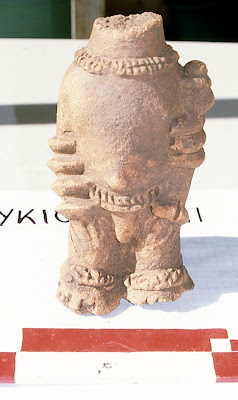
Manchester University announced yesterday, February 16th, the discovery of 80 ancient clay figures in Ghana by archaeologists from the universities of Manchester and Ghana. The sculpted human and animal figures, which are believed to be between 1,400 and 800 years old, were unearthed last month from a series of mounds in a remote region of Northern Ghana near the village of Yikpabongo. The 30km square area is so densely packed with a series of mysterious mounds that it took just two weeks to excavate the 80 figures.

Human skulls were also discovered in the mounds. Dr Benjamin Kankpeyeng from Ghana and Tim Insoll from Manchester University believe that they may be the sites of ancient shrines. It is hoped that studies of the number, context and arrangement of the figurines will provide an insight into the ritual practices and beliefs of this ancient society and deepen our understanding of what remains a relatively unknown and little-researched page of African history.

In the words of Professor Tim Insoll:

‘These finds will help to fill a significant gap in our scant knowledge of this
period before the Islamic empires developed in West Africa. They were a
sophisticated and technically advanced society: for example some of the
figurines were built in sections and slotted together.’

Dr Benjamin Kankpeyeng further explained:

‘The relative position of the figurines surrounded by human skulls means the
mounds were the location of an ancient shrine. The skulls had their jaw bones
removed with teeth placed nearby - an act of religious significance.’

However, illegal excavation of the treasures means that archaeologists are in a race against time to ensure the safety of the remains.

Residues of material were also discovered packed into holes within the figurines. What exactly was put into the holes - medicinal substances, blood or other material from a sacrifice - is unknown, however. Some of the figures have been brought back to the UK where Professor Insoll is due to carry out further analysis of these residues in an effort to uncover more clues about the society.

The burial sites have been repeatedly excavated over the past 25 years. The first excavation took place in 1985 with others in 2007, 2008 and 2009 carried out by the University of Ghana. Nevertheless, many questions remain unanswered.
Insoll explained:

‘There are still many questions remaining: some of the figurines were
deliberately broken and placed besides body parts. Why?’

Kankpeyeng added:

‘What is interesting is that the people now living in this area seem to have no
connection with the makers of the figurines. That would suggest that that they
have more in common with peoples living in other parts of West Africa - but we
need to do more work before we can be certain.’

Thursday, 11 February 2010

Mandela’s former office in Johannesburg: a derelict squat

Mandela’s former office in Johannesburg: a derelict squat
Chancellor House once housed Nelson Mandela’s law firm, which was the first black law firm in Johannesburg. The building is now in ruins and is occupied by squatters. There are plans to turn the office into a legal resource centre for young black lawyers. However, efforts to raise the necessary funds to relocate the squatters and legal negotiations have been dragging on for the past ten years.
Andrew Harding reports on BBC Radio 4.
For further information on the history of South Africa, visit our South Africa focus page.

The death of palaeography
Professor David Ganz from King’s College London is the current holder of the UK’s only chair in palaeography. The university has, however, recently, announced its decision to close the chair from September onwards. The subject will no longer exist as a separate academic discipline in British universities. Ganz has now begun to ‘fight for his subject’ and many of the world’s most eminent classicists have petitioned King’s College to reconsider its position. John Crace explains in The Guardian why the study of ancient manuscripts matters and why history will be lost without it.

The Staffordshire Hoard returns home
On Saturday, the Staffordshire Hoard will go on display, for the first time, in the county in which the treasure was found, at the Potteries Museum in Stoke-on-Trent.
Maev Kennedy reports in The Guardian.
The Staffordshire Hoard
February 13th – March 7th
The Potteries Museum & Art Gallery
Bethesda Street, HanleyStoke-on-Trent ST1 3DW
Telephone: 01782 232323
www.stoke.gov.uk

The Nazification of Carnival under the Third Reich
Siobhán Dowling reports in Der Spiegel Online on how the Nazi regime used Carnival, the pre-Lent festival celebrated predominantly in the Catholic west and south of Germany, as a propaganda tool to put forward their own notions of the German nation. There is also a slideshow of images of Carnival celebrations from the time.

Alfred Gregory: Official photographer on the 1953 Everest expedition
Alfred Gregory was the official photographer to the British expedition that made the first ascent of Everest, in 1953. He died on Tuesday, February 9th, aged 96. His obituary was published yesterday in The Independent.

Friday, 3 July 2009

Rare Photos of Colonial East Africa Online

by Kathryn Hadley

An online collection of thousands of rare photographs chronicling Europe’s colonisation of East Africa went live last week, on June 25th, on the website of the Library of Northwestern University (Illinois). The Humphrey Winterton Collection of East African Photographs: 1860-1960 includes approximately 7,610 photographs. It was assembled by the British collector Winterton over about 30 years and organised in 76 separate albums, scrapbooks or loose collections. The collection was acquired by Northwestern University’s Melville J. Herskovits Library of African Studies in 2002.

The photographs were mostly taken by explorers, military officers, colonial officials, settlers, missionaries, travellers and early commercial photographers and depict the breadth of African life during the colonial era. They include formal and informal portraits of Africans and their colonisers, photos of slaves and slave traders, of the British bombardment of Zanzibar in 1896, as well as images depicting the building of the east African railway and daily life in Africa. One of the oldest photographs in the collection shows a Zanzibar slave market in approximately 1860.

According to Jonathon Glassman, a Northwestern University associate professor of history and specialist in 19th- and 20th-century East Africa and comparative race and slavery the collection’s particular value lies in its unusual subject matter:
‘The most familiar photographs from this era tend to dwell on what photographers
considered East Africa’s glamorous aspects - its spectacular wildlife,
landscapes, settler life or the occasional posed portrait of an African sultan
or Maasai warrior […] What stands out about the collection is the large number
of items that document prosaic matters - matters that are precisely the most
difficult for the student of African history to get a handle on.’

It is possible to search for photographs by subject, keyword, people, place or time or to browse the entire collection in a way that simulates flipping through a photo album. In its pilot stage the collection was notably used to research the lineage of President Barack Obama. 31 photos of people and places were found including images of Kavirondo warriors in western Kenya from whom his father is believed to have descended.

The Winterton Collection is now the third Herskovits Library collection available online. The two others are a collection of 113 antique African maps dating from the 16th to the early 20th century and a collection of 590 posters reflecting the culture and politics of contemporary African nations. It is available on the website of the website of Northwestern University Library.
http://www.library.northwestern.edu/

For further information on various aspects of African history, visit our Africa focus page.

Tuesday, 23 June 2009

Mau Mau Veterans Sue British Government


by Kathryn Hadley

Today, June 23rd, five Kenyan veterans of Kenya’s struggle for independence presented the London High Court with a case against the British government for human rights abuses in the 1950s and 1960s. The five Kenyans, three men and two women all in the their 70s and 80s, have called for the British government to acknowledge its responsibility in the alleged crimes which it committed in the pre-independence era, in particular during and in the aftermath of the Mau Mau uprising. They have also demanded the government to offer them adequate compensation for the atrocities which they suffered.

The claim was presented to the London High Court by the Mau Mau War Veterans' Association and the Kenya Human Rights Commission, through the London law firm Leigh Day & Co. Quoted in an article on the BBC website, the veterans’ lawyer, Martyn Day, said that he believed his clients had ‘a good chance of success’. He also explained:
‘We want the British government to say what we did was so wrong back in the
1950s’.

The British government has, however, argued that the claim is invalid because of the time that has lapsed since the alleged abuses.

The uprising began in the European-owned farmlands in central Kenya, in 1952, when Mau Mau fighters launched attacks against white settlers in an attempt to reclaim land that had been seized by the British colonial authorities. In reaction to the attacks, the British army rounded-up thousands of people and placed them in camps. Kenyan veterans of the uprising say that they suffered barbaric treatment. Ndiku Mutua, one of the five veterans, was arrested in 1954, severely beaten and castrated with pliers, at Lukenya detention centre. He was quoted in the same article on the BBC website:
‘I live with the physical and mental scars of what happened to me [...] Not a
day goes by when I do not think of these terrible events. At last I can tell my
story and at last I can hope for justice from the British courts.’

Another claimant, Paulo Nzili, said that he too was castrated. The third male claimant, Wambugu Wa Nyingi, explained that he was tied upside down by the feet and beaten. The two female veterans, Jane Muthoni Mara and Susan Ngondi, were both sexually assaulted. At the beginning of last month, lawyers claimed that they had documented 40 cases of torture, including castration, sexual abuse and unlawful detention. According to the Kenya Human Rights Commission, 90,000 Kenyans were executed, tortured or maimed during the crackdown, and 160,000 were detained in appalling conditions.

It is not the first claim brought by Kenya’s former independence fighters against the British government. A formal claim for compensation was notably filed against the British government by six former Mau Mau fighters in October 2006.

For further information, read our article Burying the Bones of the Past.
For further information about how the Freedom of Information Act may have been used to protect the perpetrators of a war crimes in Kenya, read our article A Very British Massacre

Monday, 15 June 2009

Forward to Freedom

by Kathryn Hadley

‘Forward to Freedom’ opened last Friday, June 12th, at the Museum of London to mark the fiftieth anniversary of the Anti-Apartheid Movement (AAM). Showcasing posters, stickers, badges, leaflets, photographs and footage of anti-apartheid demonstrations, the display reveals the diversity of the campaigns across Britain against apartheid and minority white rule, which ranged from cultural, to sport, to consumer boycotts. The display is organised in partnership with the Anti-Apartheid Movement Archives Committee and the Bodleian Library, which holds most of the archives. Anti-apartheid campaigners fought for almost fifty years before Nelson Mandela was eventually released from prison, in February 1990. Apartheid was officially abolished, in 1994, when he was elected to power in the first post-apartheid general elections.

The policy of apartheid was adopted in South Africa when the National Party, founded by Afrikaner nationalists in 1914, came to power in 1948. At the time, 70% of the population in South Africa was African, 17% was white and 13% was ‘Coloured’ (i.e. of mixed descent) or Indian. The white population owned 87% of the land. The African population owned the remaining 13% of the land. The Coloured and Asian populations had no land rights; they merely had resident rights. In accordance with the policy of ‘divide and rule’, Africans were placed in homelands and their movement outside the homelands was controlled by passes. It is estimated that by the 1980s approximately 3.5 million people had been uprooted from their homes.

It was not until June 26th 1959, however, ten years after the institution of apartheid in South Africa, that the Boycott Movement, which later became the AAM, was founded. The movement initially called for a boycott of fruit, cigarettes and other goods imported from South Africa. It soon grew, however. Opposition spread to a wide range of other fields and the AAM moved beyond being a British London-based movement, seeking to influence the policies of international organisations such as the United Nations and the International Olympic Committee.
In Britain, local authorities began to issue declarations against apartheid and, by 1985, over 120 local authorities had taken anti-apartheid action. A poll in 1986 also revealed that over a quarter of British people did not buy goods from South Africa. In 1964, the labour government imposed a ban on arms deals with South Africa (there allegedly remained loopholes, however, and the ban was lifted by the Conservative government in 1970). The boycott became a global measure in 1977, when the United Nations Security Council imposed an international ban on arms trade with South Africa. South Africa’s diplomatic relations were also affected. Following pressure from African and Asian countries and Canada, South Africa withdrew from the Commonwealth, in 1961 and, in 1963, the United Nations General Assembly called its members to end trade and diplomatic relations with South Africa.

British and international boycotts also extended to the cultural and sporting scenes. The ‘Public Declaration of Playwrights against apartheid’ signed by authors such as Samuel Beckett, Graham Greene, Harold Pinter and Arthur Miller imposed a cultural boycott on South Africa. In sport, South Africa was excluded from the Tokyo Olympic Games, in 1964. The Springbok rugby tour matches in Britain, from October 1969 to February 1970, were disrupted by protests and the Springboks were excluded from the first two rugby world cups in 1987 and 1991. By 1990, South Africa was expelled from every major world sports federation.

The ‘Nelson Mandela: Freedom at Seventy’ campaign, in 1988, was one of the last major campaigns led by the Anti-Apartheid Movement in an attempt to secure Nelson Mandela’s release from prison for his seventieth birthday. In 1989, the Harare Declaration was endorsed by the United Nations Security Council, setting the necessary conditions for negotiations to end apartheid.

The display is a credit to the resilience of those who supported and fought for the AAM, battling in Britain and exporting their campaigns worldwide to a wide range of different spheres. Nevertheless, it also raises a number of questions. Why did victory not come sooner? Why did the movement not begin earlier, immediately after apartheid became the official policy of the National party government in 1948? What sparked the protest movements at the beginning of the 1960s?

Cristabel Gurney is a member of the Anti-Apartheid Movement Archives Committee and became involved in the AAM as a student. She participated in the protests against the Springbok rugby tour matches, the Barclays Bank boycott and became the editor of Anti-Apartheid News, the movement’s weekly newspaper. Meeting her at the exhibition, I confronted her with some of my questions…

According to Gurney, the fight against minority white rule and racial discrimination on a larger scale was sparked by the Sharpeville massacre on March 21st, 1960. It was also inspired by the Civil Rights movement in the United States, which gained momentum in the late 1950s and early 1960s. Anti-apartheid protests were not new, however, in the 1960s. Further research into anti-apartheid movements in the 1950s is necessary. Nevertheless, student protests were organised in the 1950s and, from 1955, Labour Party conferences passed resolutions questioning South Africa’s fitness to be a member of the Commonwealth. The Sharpeville massacre exported the fight, however, to the global scene. Within a month of the massacre, the African National Congress and the Pan Africanist Congress, which had led the Sharpeville protest, were banned and hundreds of Congress Movement and Liberal Party activists were detained. Some fled abroad, turning overseas for support. Gurney explained the origins of the Anti-Apartheid Movement in an article published for History Today in 1999, to mark the fortieth anniversary of the foundation of the AAM. For further information, read When the Boycott Began to Bite

On June 26th, ACTSA will host a conference to mark the anniversary of the foundation of the AAM. Speakers, including Abdul Minty, the founder of the AAM, members of the movement during apartheid, Glenys Kinnock MEP and Jon Snow, will discuss the achievements of the AAM, the lessons of its campaigns and how they can be applied to the issues facing southern Africa today. In the afternoon, various workshops will consider some of these issues and produce proposals for action. Her Excellency, Lindiwe Mabuza, South African High Commissioner will host a reception in the evening.

Making hope a reality: Celebrating the past, building the future
June 26th

South African High Commission
South Africa House
Trafalgar Square
London WC2N5DP
Telephone: 020 3263 2001
http://www.actsa.org/
Pictures:
- Stop the apartheid bomb poster, produced as part of the campaign to end military and nuclear collaboration with South Africa in the 1980s (Anti-Apartheid Movement Archives)
- Consumer boycott poster encouraging shoppers to boycott South African goods, produced by the Anti-Apartheid Movement (Anti-Apartheid Movement Archives)
- Demonstration in Trafalgar Square, 25 March 1990 (Anti-Apartheid Movement Archives, Courtesy of the International Defence and Aid Fund for Southern Africa)
- Boycott Barclays poster, produced as part of the 16-year campaign to force Barclays to withdraw from South Africa in the 1970s (Anti-Apartheid Movement Archives)

Monday, 18 May 2009

Painting A Wall

by Kathryn Hadley

Painting A Wall opened on Thursday last week at the Finborough Theatre, to coincide with South Africa’s recent general elections. The play is set in Cape Town, in 1970, and explores the life of four Cape Coloured South African painters living under apartheid. Cape Coloureds refers to the modern-day descendants of slave labourers imported into South Africa by Dutch settlers, as well as to other groups of mixed ancestry. Under apartheid, the term Cape Coloureds referred to a specific category of Coloured South Africans amongst a variety of Coloured subgroups, which were defined by the apartheid bureaucracy. The policy of apartheid was adopted in South Africa when the National Party, founded by Afrikaner nationalists in 1914, came to power in 1948.

The title largely sums up the play. When the play begins the wall is bare; an hour later it is painted green. Throughout the duration of the play, the audience witnesses Peter, Henry, Willy and Samson painting the wall. The only element of staging is the wall; their life is painting the wall; and their only prospects are painting other walls (or, as Samson points out, lots of walls at once if they paint a house!).

The play is absurd and to a degree seems pointless. But the lives of the painters are also absurd and pointless. Beyond the monotony of painting the wall, lies an extensive use of symbolism, which indirectly raises important political issues about apartheid, the condition of Coloured workers and colonialism.

The wall, which must be painted white to comply with government regulations, is owned by the South African ‘white’ government and is a symbol of the oppressive rule of the National Party. The wall is a trap and a barrier. It is hard and unflinching and the four painters are unable to see what is beyond the wall. According to Willy, employing them to paint the wall is merely a way of keeping the Coloureds busy so that they are unable to do ‘anything else’. It is a means of preventing unrest, but also a means of narrowing their life prospects and keeping them under the tutelage of the ‘white’ government. The four men paint the wall and have no formal education. They speak pidgin English and Afrikaans and are prisoners of their limited vocabulary and inability to communicate. As Willy says, he only really knows five words, two of which are ‘wall’ and ‘paint’! He is unable to express himself, to fight for his rights, to get over the wall and to escape his life as a painter.

The four men are trapped in the world of being Coloured painters employed by the ‘white’ government and their lives have turned to absurdity. Their jobs are pointless, if they are merely employed in order to be kept under the government’s control. Their day’s work is absurd because they have been delivered the wrong colour of paint. They have to paint the wall to earn their daily wage, but will have to repaint it white the following day.

The absurdity of their lives is all the more tragic because all four characters are aware of their condition. They deal with it in different ways. They laugh and joke, they cry and even attempt suicide, they get on with their jobs or they run away. They shout and they fight. Samson’s constant repetition of the phrase ‘tell me if anything at all was done’ appears a sign of insanity.

However, even the realisation of their condition is futile because they remain trapped. Henry and Samson are in desperate need of their jobs in order to support their families. Their individuality is suppressed. Henry is a talented painter, but his talent is wasted because painting a wall requires no creativity. He paints a picture on the wall, but he eventually has to paint over it. Their lives are wasted. At the end of the play, when they have finished painting the wall, Willy asks where they are now going. They do not know. They will go where they are told. They will paint the next wall with the paint they are given and, if the paint is the wrong colour, they will paint the wall again. They will not escape and, despite moments of frustration and threats to leave and to never paint walls again, they will remain painters.

The play is somewhat frustrating because it lacks dynamism. But this lack of dynamism is a wider reflection of the lives of the painters, which lead nowhere. The play is most frustrating because of the message of hopelessness which it conveys. It requires patience in order to decipher and reflect on the various issues about South Africa, apartheid, racism, white rule and colonialism which it raises, albeit subtly and discreetly.

For further information on the origins of the British movement to oppose apartheid, read our article When the Boycott Began to Bite For further information on the ‘Border War’ fought to maintain apartheid, read our article South Africa’s Forgotten War

Painting A Wall
May 12th – June 6th
Finborough Theatre
118 Finborough Road
London SW10 9ED
www.finboroughtheatre.co.uk

Friday, 24 April 2009

The Long and Winding Road to the Discovery of Cleopatra’s Tomb?


by Kathryn Hadley

Cleopatra’s tomb has never been found and its location remains uncertain.
22 bronze coins inscribed with Cleopatra’s name... An alabaster mask with a cleft chin resembling Mark Antony’s face... Shafts and tunnels beneath the temple of Taposiris Magna in Alexandria... The discovery, last week, of a nearby cemetery containing ten gilded mummies indicating the burial sites of members of the nobility…

A team of archaeologists from Egypt and the Dominican Republic believe that they may, at last, be on the path to the discovery of the tomb of Cleopatra and her lover Mark Antony. Evidence of their latest discoveries was presented, last Sunday, by Zahi Hawass, the head of Egypt’s Supreme Council of Antiquities, who claimed that:
‘This could be the most important discovery of the 21st century […] This is the
perfect place for them to be hidden.’

Previous archaeological research had focused on a site in Alexandria which had been submerged by the sea in an earthquake in the 8th century. Kathleen Martinez, a Dominican Republic scholar, initiated research at the current site, situated in Burg Al Arab, 30 miles (50km) west of Alexandria. The temple, devoted to the goddess Osiris, the god of the afterlife, was built by Ptolemy II (282-246 BC). Martinez has studied the life of Cleopatra for the past 12 years and has been working on the site with her team for three years. Following a series of radar surveys in March, archaeologists discovered three chambers buried almost 20 metres underneath the rock and Martinez believes that Antony and Cleopatra may be buried together in one of the chambers.

She was quoted in an article published by Reuters at the beginning of the week:
‘[Cleopatra] needed a place to be protected in the afterlife […] If she had used
the other burial site, she would have disappeared forever.’
Martinez explained that the couple would have been buried in a temple rather than in a public burial in order to protect them from the Romans and told The Associated Press that she believed them to be buried at Taposiris Magna
‘because it was the most sacred temple of its time.’

Cleopatra allegedly committed suicide by means of an asp bite on August 12th in 30 BC, aged 39, following her and Mark Antony’s defeat against Gaius Julius Caesar Octavian. The main source for her death and burial is provided by the posthumous account of Plutarch who wrote 130 years after the event and claimed that the two loves were buried together.

Archaeologists plan to start digging as soon as possible. At the beginning of the week, however, there were fears that digs would have to be postponed until the autumn for security reasons because the site overlooks the summer residence of the Egyptian President Hosni Mubarak!

For further information on our perceptions of Cleopatra, read our articles Cleopatra’s Make-over and Cleopatra: From History to Myth.

Tuesday, 10 February 2009

Discovery of 30 Egyptian Mummies


by Kathryn Hadley

Yesterday, the Egyptian government announced the discovery (reported by The Associated Press and Reuters) of approximately 30 Egyptian mummies inside a 2,600-year-old tomb at the necropolis of Saqqara, to the south of Cairo. The tomb was discovered at the bottom of a 36-foot deep shaft and the mummies were placed in niches along the tomb’s walls. Eight sarcophagi were also found, one of which contained another mummy. The other seven have yet to be opened, but it is believed that they also contain mummies. The tomb was described by Zahi Hawass, Egypt’s top archeologist, as a ‘storeroom for mummies’, which dates back to 640 BC at the time of the 26th Egyptian Dynasty, the last native dynasty to rule the Egyptian kingdom before it was overthrown by the Persians in 525 BC. The tomb is, however, situated at an older site, from the period of the Old Kingdom, approximately 4,300 years ago. Abdel Hakim Karar, an assistant to Hawass, dated the tomb to the Old Kingdom, possibly the Fifth Dynasty, which ruled from approximately 2,494 bc to 2,345 bc.

The majority of the mummies are poorly preserved and archaeologists have yet to identify the bodies and to explain why so many were placed in one room. The name Badi N Huri was engraved in the opened sarcophagus, but the wooden coffin inside did not bear a title for the mummy. According to archaeologists, it is unusual for mummies to be buried in niches as late as the 26th Dynasty. It is also rare to find preserved burials in well-known necropolises such as Saqqara, which served the nearby city of Memphis, the capital of Ancient Egypt, because the tombs were often raided by thieves in ancient times. In the words of Abdel Hakim Karar:


"Niches were known in the very early dynasties, so to find one for the 26th
Dynasty is something rare".

Excavations at Saqqara began 150 years ago and have since uncovered a necropolis of pyramids as well as tombs, mostly from the Old Kingdom. Excavations have primarily focused on just one side of the two main pyramids, the Step Pyramid of King Djoser, one of the largest ancient stone structures in the world dating from about 2,650BC, and the pyramid of Unas, the last king of the Fifth Dynasty. In December, two rock-cut tombs were notably found in the Saqqara necropolis, 400 metres south of the Step Pyramid, near the current discovery site. The tombs were both those of high officials: the first was that of Iya-Maat, who bore the title ‘supervisor of the king’s property’ and was responsible to King Unas for bringing stones from the quarries for the construction of the nearby tombs; the second tomb belonged to Thinh, a Fifth Dynasty singer and, in the words of the engraving at the front of the tomb, the ‘supervisor of all singers’ who was in charge of providing entertainers for the pharaohs.

The area where the current tomb was found, to the southwest of the main pyramids, remains relatively unexplored. According to Hawass, only 30% of Egypt’s pyramids have been uncovered.

For information on ‘mummy making’, read our article The Making of a Modern Mummy

Further information on the discoveries and excavations led by Hawass is available on the official website of Dr Zahi Hawass
www.guardians.net/hawass.

The website of the Friends of Saqqara Foundation also provides information on Dutch excavations at Saqqara. It is regularly updated with news of the latest discoveries and provides a useful history of the site of Saqqara
www.saqqara.nl

Thursday, 18 December 2008

Glimmer of Sudan’s rich cultural history

by Kathryn Hadley

Three ancient statues engraved with a little understood sub-Saharan language have recently been unearthed at the archaeological site of el-Hassa, approximately 120 miles north of the Sudanese capital, Khartoum. For the past six years, since the beginning of the conflict in Darfur in February 2003, Sudan has tended to feature in the news primarily as an area of war and atrocities. The recent discoveries provide, however, an insight into the richness of the country’s past and cultural history.

The statues represent three rams symbolising the god Amun and are engraved with a royal dedication in Meroitic script. The Meroitic script is possibly the oldest written sub-Saharan language, dating from the Meroe period, between 300BC and AD450. The language is relatively unknown and experts are now attempting to decipher the inscriptions. The excavations, which are being financed by the French foreign ministry, began in 2000 and have since revealed substantial information on the reign of the king Amanakhareqerem, who is also mentioned in the inscriptions on the rams.

In the words of the French archaeologist Vincent Rondot, the leader of the project:
It is one of the last antique languages that we still don't understand. We can read it. We have no problem pronouncing the letters. But we can't understand it, apart from a few long words and the names of people... It is absolutely essential to understand it... We only need to read the last words remaining on the inscription
The Meroitic kingdom of Sudan was situated around the Sixth Cataract of the Nile. It developed independently of Egypt, which had previously exerted considerable influence on the region. At the height of its power, during the second and third centuries BC, the Meroitic kingdom extended from the Third Cataract of the Nile to Soba in the South. The rulers of Meroe appear to have remained, however, influenced by the Pharaonic tradition. They erected stelae to commemorate their achievements and constructed pyramids to contain their tombs.

In the first century BC, however, they gradually changed their writing style from hieroglyphs to the Meroitic script, which was adapted to the indigenous Nubian language. The Meroitic kingdom gradually declined in the fourth century as the Ethiopian kingdom of Aksum in the East expanded; by AD350, King Ezana of Axum had captured and destroyed Meroe city.

The project is described on this website, from the French Ministry of Foreign Affairs.

The History Today archive has featured Sudanese history in its latter stages, most notably in articles on the 1888 Fashoda Incident, and covering the British General and Victorian hero Gordon's raid on Khartoum.

Thursday, 30 October 2008

Anti-apartheid writer, Es’kia Mphahlele, dies

by Kathryn Hadley

The prominent South African academic and writer, Es'kia Mphahlele, died on October 27th, aged 88. He was particularly famous for his autobiography Down Second Avenue (1959) about his life as a herdsman, teacher and journalist for the magazine Drum.

He became a teacher, but was banned from teaching in the early 1950s as a result of his opposition to the 1953 Bantu Education Act, which notably enforced the separation of races in all educational institutions.

In 1957, Mphahlele went into exile from apartheid South Africa. During his twenty years of exile he spent time in France, Nigeria, Zambia and Kenya. In 1968 he gained a doctoral degree in the United States from the University of Denver in 1968 and became a professor at the University of Pennsylvania. In 1969 he was nominated for the Nobel Prize for Literature.

Upon his return to South Africa in 1977, he became the first black professor at the University of Witwatersrand and founded the school’s African Literature Department. In 2002, he founded the Es’kia Institute for the development of the arts and the preservation of African heritage.

In 1994, after the end of apartheid, President Nelson Mandela awarded Mphahlele the Order of the Southern Cross, one of the highest recognitions granted by the South African government.
“African literature is an awakening. It represents moments of consciousness when
we have been jolted into awareness of what Europe did to us and what we have
been doing about this disinherited personality we now possess”.
Mphahlele, in 1983.

For more on Britian and apartheid see the article in the History Today archive
When the Boycott Began to Bite

Thursday, 25 September 2008

History in the News: Orphans of History - their fight for official recognition continues

Soldiers graffiti and engravings on a painting done by harkis, Fort de Cormeilles-en-Parisis.     Photographer : Jean-noël Lafargue. Copyleft: This work of art is free; you can redistribute it and/or modify it according to terms of the Free Art License. You will find a specimen of this license on the site Copyleft Attitude http://artlibre.org/licence/lal/en/ as well as on other sites.
Soldiers graffiti on a painting by harkis, Fort de Cormeilles-en-Parisis, France.

25th September 2008: 8th journée nationale d’hommage aux harkis.

by Kathryn Hadley

The first national day of commemoration for the harkis, the Algerian nationals who fought alongside the French during the Algerian War, was celebrated in 2001 under Jacques Chirac’s presidency. It was both a reflection of French attempts to defend its republican ideals of unity and solidarity and of practical concerns for the integration of the harkis into the French national community.


Chirac argued in his speeches at the time that the recognition of the harkis sacrifices, and of some of the shortcomings of French colonial policy, was a question of honour and duty. Following the signature of the Evian Agreements in 1962, approximately 150,000 harkis were massacred by the the Algerian independence force (FLN). The French army was ordered not to intervene and the Gaullist government severely limited the repatriation of harkis back to France.

The decree of 31st March 2003 formally incorporated the journée nationale into the calendar of national commemorative ceremonies. It stipulated that an official ceremony would be held in Paris every 25th September and that the regional prefects were responsible for the organisation of local celebrations in their department.

In previous years, however, there has been very scant coverage of the journée nationale in the national press. This year, news of the programme of celebrations is similarly very difficult to find in both the national and local press. On the websites of three of the biggest national newspapers Le Figaro, Le Monde and Libération there is no mention of the journée nationale; nor is there any coverage of the ceremony in Paris in the local Parisian paper Le Parisien.

Abdelkrim Barki, an harki veteran in his 70s, was repatriated to France in 1962. When I interviewed him in December last year, he described the official institution of the journée nationale last year as is ‘que du bla bla'. It appears that this supposed national day of celebration remains a meaningless and empty promise of recognition.

Do you have an opinion on the topic? Comment below this article.

Or find out more on the subject from our archives and links.


Blog Directory